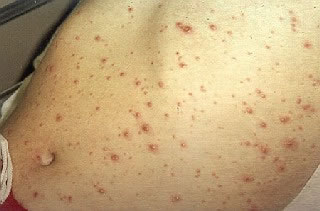
Is this your child's symptom?
- A rash all over the body caused by the chickenpox virus.
- The chickenpox rash starts as small red bumps. The bumps change to blisters or pimples. The bumps change to open sores, and finally they scab over.
- A doctor has told you that your child has chickenpox.
- Or your child had close contact with another person who has it (or shingles). The contact should be 10-21 days earlier.
Symptoms of Chickenpox
- Chickenpox starts with some small water blisters or pimples on the head and trunk.
- Chickenpox progress within 24 hours through the next 5 stages:
- Small red bumps
- Thin-walled water blisters
- Cloudy blisters
- Open sores, and finally
- Dry brown crusts.
- Rash is all over the body. Most often, starts on the head and back.
- Repeated crops of new chickenpox keep appearing for 4 to 5 days. Therefore, all 5 stages are present at same time.
- Sores (ulcers) can also occur in the mouth, on eyelids, and on genitals.
- Fever is most often present. The more the rash, the higher the fever.
- Known contact to a child with chickenpox or shingles 10 - 21 days earlier
- Main related problems: skin infections from scratching.
Cause of Chickenpox
- Chickenpox is caused by a virus. It is called Varicella.
- Chickenpox can be prevented by getting this vaccine against this virus.
When to Call for Chickenpox
Call 911 Now
Go to ER Now
Call Doctor or Seek Care Now
|
Contact Doctor Within 24 Hours
Contact Doctor During Office Hours
|
Self Care at Home
|
Call 911 Now
- Not moving or too weak to stand
- You think your child has a life-threatening emergency
Go to ER Now
- Stiff neck (can't touch chin to the chest)
- Hard to wake up or confused when awake
Call Doctor or Seek Care Now
- Bright red skin or red streak
- Very painful swelling or very swollen face
- New red rash in addition to chickenpox rash
- Walking is not steady
- Trouble Breathing
- Bleeding into the chickenpox
- Fever higher than 104° F (40° C)
- Age less than 1 month old
- Vomits 3 or more times
- Eye pain or constant blinking
- Took a steroid medicine within past 2 weeks
- Weak immune system. Examples are: sickle cell disease, HIV, cancer, organ transplant, taking oral steroids.
- Chronic skin disease (such as eczema)
- Chronic lung disease (such as cystic fibrosis)
- Your child looks or acts very sick
- You think your child needs to be seen, and the problem is urgent
Contact Doctor Within 24 Hours
- Age less than 1 year old
- Teen 13 years or older has chickenpox
- Been near to person with chickenpox or shingles in last 5 days. Also, healthy person who never had a chickenpox vaccine.
- One lymph node gets larger and more tender
- Fever lasts more than 4 days
- Fever returns after being gone more than 24 hours
- Scab or sore drains yellow pus
- One sore gets much larger in size than the others
- Gets new chickenpox after day 6
- You think your child needs to be seen, but the problem is not urgent
Contact Doctor During Office Hours
- You have other questions or concerns
Self Care at Home
- Chickenpox with no other problems
Care Advice for Chickenpox
What You Should Know About Chickenpox:
- Chickenpox is caused by the varicella virus.
- It's now uncommon because of the chickenpox vaccine.
- Your job is to keep your child comfortable and to limit the itching.
- Here is some care advice that should help.
Cool Baths for Itching:
- For itching, give cool or lukewarm baths for 10 minutes as often as needed.
- Caution: avoid any chill.
- Can add baking soda 2 ounces (60 mL) per tub.
- Baths don't spread the chickenpox.
- Do not use soaps. Reason: soaps cause dry skin and make the itch worse.
Calamine Lotion for Itching:
- Put calamine lotion on the chickenpox that itch the most.
- You can also use an ice cube on the itchy spots for 10 minutes.
- Don't use any lotion containing Benadryl in it. Reason: it can be absorbed across the skin. This can cause side effects in kids.
Allergy Medicine for Itching:
- If itching becomes severe, give a dose of Benadryl.
- No prescription is needed. Age limit: 1 and older.
Try Not to Scratch:
- Try not to let your child pick and scratch at the sores. This can lead to infected sores.
- Trim fingernails.
- Wash hands often with soap.
Fever Medicine:
- Give acetaminophen (such as Tylenol) for fever higher than 102° F (39° C).
- Never use aspirin. Reason: risk of Reye syndrome.
- Also, don't use ibuprofen products (such as Advil). Reason: may increase risk of bad strep skin infections.
Fluids and Soft Diet:
- The mouth and throat ulcers are painful. Try to get your child to drink adequate fluids.
- Goal: keep your child well hydrated.
- Cold drinks, milk shakes, popsicles, slushes, and sherbet are good choices.
- Solids. Offer a soft diet. Also, avoid foods that need much chewing. Avoid citrus, salty, or spicy foods. Note: fluid intake is more important than eating any solids.
- For babies, you may need to stop the bottle. Give fluids by cup, spoon or syringe instead. Reason: the nipple can increase the pain.
Liquid Antacid for Mouth Pain (Age 1 Year and Older):
- For mouth pain, use a liquid antacid (such as Mylanta or the store brand). Give 4 times per day as needed. After meals often is a good time.
- Age 1 to 6 years. Put a few drops in the mouth. Can also put it on with a cotton swab.
- Age over 6 years. Use 1 teaspoon (5 mL) as a mouth wash. Keep it on the ulcers as long as possible. Then can spit it out or swallow it.
- Caution: do not use regular mouth washes, because they sting.
Ointment For Pain With Passing Urine:
- For girls with painful genital ulcers, use petroleum jelly (such as Vaseline).
- Put on the sores as needed.
- For males with painful pox on the tip of the penis, this also works.
Return to School:
- Your child can go back to school after all the sores have crusted over.
- Most often, this is day 6 or 7 of the rash.
What to Expect:
- Expect new chickenpox every day for 4 or 5 days.
- Most children get 400 to 500 chickenpox.
- They get less pox if they've had the vaccine.
Prevent the Spread of Chickenpox in the Office:
- If your child needs to be seen, call first to the office.
- Try to bring another adult. Have one adult enter the office first for instructions.
- For nonurgent problems, the doctor may do an exam in the car.
Call Your Doctor If:
- Chickenpox look infected (draining pus, scabs become larger)
- Gets any new chickenpox after day 6
- You think your child needs to be seen
- Your child becomes worse