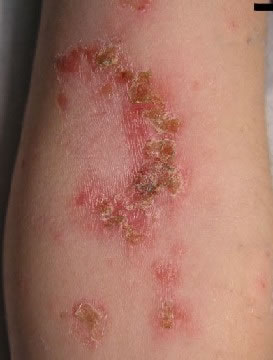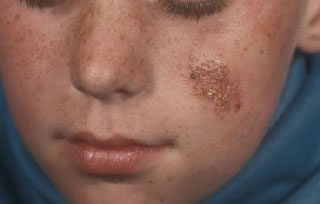
Is this your child's symptom?
- Coin-shaped sores on the skin covered by scabs
- The infected crusts are the color of honey
- Skin infection caused by a bacteria
Symptoms of Impetigo
- Sores smaller than 1 inch (2.5 cm)
- Often covered by a soft, yellow-brown scab or crust
- Scabs may drain pus or yellow fluid off and on
- Starts as small red bumps. These change quickly to cloudy blisters or pimples. Then, they become open sores which drain fluid or pus.
- Sores increase in size
- Any sore or wound that grows and doesn't heal is usually impetigo.
Cause of Impetigo
- A skin infection caused by a bacteria. It starts in a small break in the skin. Examples are a scratch or insect bite.
- The most common bacteria are Staph and Strep. If the child has a sore throat, they may also have Strep throat. A rapid Strep test will give the answer.
- Impetigo often spreads and increases in number from scratching.
When to Call for Impetigo - Infected Sores
Call Doctor or Seek Care Now
|
Contact Doctor Within 24 Hours
Contact Doctor During Office Hours
|
Self Care at Home
|
Call Doctor or Seek Care Now
- Pink or tea-colored urine
- Fever and spreading redness around the impetigo
- Your child looks or acts very sick
- You think your child needs to be seen, and the problem is urgent
Contact Doctor Within 24 Hours
- Spreading redness around the impetigo and no fever
- Fever or sore throat are present
- Sore is larger than 1 inch (2.5 cm) across
- Sores and crusts inside the nose
- Fluid-filled blisters on the face
- Impetigo gets worse after 48 hours on antibiotic ointment
- You think your child needs to be seen, but the problem is not urgent
Contact Doctor During Office Hours
- Impetigo in 2 or more children (such as siblings or play groups)
- Child plays contact sports. Reason: to prevent spread.
- 3 or more impetigo sores. Reason: may need an oral antibiotic. Many of these children also have a Strep throat.
- Not healed up after 1 week on antibiotic ointment
- You have other questions or concerns
Self Care at Home
- Mild impetigo (1 or 2 sores that started with a scratch or insect bite)
Care Advice for Impetigo
What You Should Know About Impetigo:
- Impetigo is a skin infection. Most often, it starts in a scratch or insect bite.
- It usually responds to treatment with any antibiotic ointment.
- Here is some care advice that should help.
Remove Scabs:
- Soak off the scab using soap and warm water. The bacteria live underneath the scab.
Antibiotic Ointment:
- Put an antibiotic ointment (such as Polysporin) on the sores. No prescription is needed. You can also use one you already have.
- Do this 3 times per day.
- Cover it with a bandage to prevent scratching and spread.
- Repeat the washing, ointment and dressing 3 times per day.
Do Not Pick at the Sores:
- Help your child not to scratch and pick at the sores. This spreads the impetigo.
Return to School:
- Impetigo is spread to others by contact with skin lesions.
- Wash the hands often. Try not to touch the sores.
- For mild impetigo (1 or 2 sores), can go to school if it is covered.
- For severe impetigo, child needs to take an oral antibiotic for more than 24 hours. Then your child can go back to school.
- Contact Sports. In general, needs to be on antibiotics for 3 days before returning to sports. There must be no pus or drainage. Check with the team's trainer if there is one.
What to Expect:
- Sore stops growing in 1 to 2 days.
- The skin is healed in 1 week.
Call Your Doctor If:
- Impetigo sore gets bigger after 48 hours on antibiotic ointment
- Gets new impetigo sore on antibiotic ointment
- Not healed up in 1 week
- You think your child needs to be seen
- Your child becomes worse