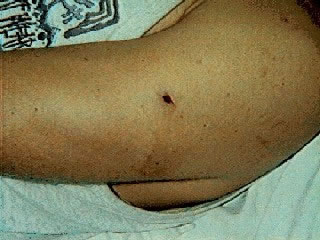
Is this your child's symptom?
- The skin is punctured by a pointed narrow object
Causes of Puncture Wounds
- Metal: nail, sewing needle, pin, tack
- Pencil: pencil lead is actually graphite (harmless). It is not poisonous lead. Even colored leads are not toxic.
- Wood: toothpick
Complications of Puncture Wounds
- Retained Foreign Object. This happens if part of the sharp object breaks off in the skin. The pain will not go away until it is removed.
- Wound Infection. This happens in 4% of foot punctures. The main symptom is spreading redness 2 or 3 days after the injury.
- Bone Infection. If the sharp object also hits a bone, the bone can become infected. Punctures of the ball of the foot are at greatest risk. The main symptoms are increased swelling and pain 2 weeks after the injury.
When to Call for Puncture Wound
Call 911 Now
Go to ER Now
Call Doctor or Seek Care Now
|
Contact Doctor Within 24 Hours
Contact Doctor During Office Hours
|
Self Care at Home
|
Call 911 Now
- Deep puncture on the head, neck, chest, back or stomach
- You think your child has a life-threatening emergency
Go to ER Now
- Bleeding that won't stop after 10 minutes of direct pressure
- Puncture on the head, neck, chest, or stomach that could be deep
- Tip of the object broke off in the body
Call Doctor or Seek Care Now
- Puncture into a joint
- Feels like something is still in the wound
- Won't stand (bear weight or walk) on punctured foot
- Needlestick from used needle (may have been exposed to another person's blood)
- Sharp object or setting was very dirty (such as a playground or dirty water)
- No past tetanus shots. Note: tetanus is the "T" in DTaP, TdaP, or Td vaccines.
- Dirt in the wound is not gone after 15 minutes of scrubbing
- Severe pain and not better 2 hours after taking pain medicine
- Wound looks infected (spreading redness, red streaks)
- Fever
- You think your child has a serious injury
- You think your child needs to be seen, and the problem is urgent
Contact Doctor Within 24 Hours
- Last tetanus shot was more than 5 years ago
- You think your child needs to be seen, but the problem is not urgent
Contact Doctor During Office Hours
- You have other questions or concerns
Self Care at Home
- Minor puncture wound
Care Advice for Puncture Wound
What You Should Know About Puncture Wounds:
- Most puncture wounds do not need to be seen.
- Here is some care advice that should help.
Cleaning the Wound:
- First wash off the foot, hand or other punctured skin with soap and water.
- Then soak the puncture wound in warm soapy water for 15 minutes.
- For any dirt or debris, gently scrub the wound surface back and forth. Use a wash cloth to remove any dirt.
- If the wound re-bleeds a little, that may help remove germs.
Antibiotic Ointment:
- Use an antibiotic ointment (such as Polysporin). No prescription is needed.
- Then, cover with a bandage. This helps to reduce the risk of infection.
- Re-wash the wound and put on antibiotic ointment every 12 hours.
- Do this for 2 days.
Pain Medicine:
- To help with the pain, give an acetaminophen product (such as Tylenol).
- Another choice is an ibuprofen product (such as Advil).
- Use as needed.
What to Expect:
- Puncture wounds seal over in 1 to 2 hours.
- Pain should go away within 2 days.
Call Your Doctor If:
- Dirt in the wound still there after 15 minutes of scrubbing
- Pain becomes severe
- Looks infected (redness, red streaks, pus, fever)
- You think your child needs to be seen
- Your child becomes worse