Is this your child's symptom?
- Injuries to the skin anywhere on the body surface
- Includes cuts, scratches, scrapes, bruises and swelling
Types of Skin Injury
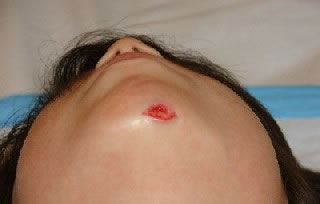
- Cuts, lacerations, gashes and tears. These are wounds that go through the skin to the fat tissue. Caused by a sharp object.
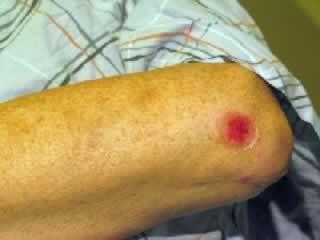
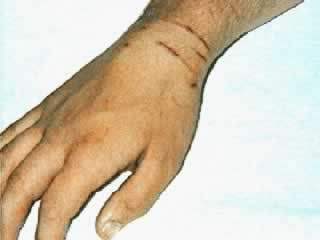
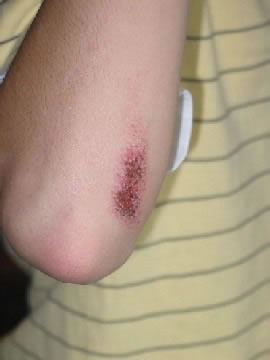
- Scrapes, abrasions, scratches and floor burns. These are surface wounds that don't go all the way through the skin. Scrapes are common on the knees, elbows and palms.
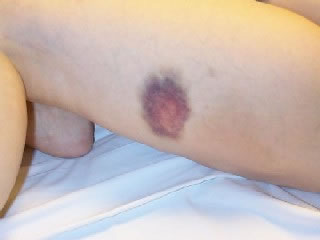
- Bruises. These are bleeding into the skin from damaged blood vessels. Caused by a blunt object. They can occur without a cut or scrape.
When Sutures (Stitches) are Needed for Cuts
- Any cut that is split open or gaping needs sutures.
- Cuts longer than ½ inch (12 mm) usually need sutures.
- On the face, cuts longer than ¼ inch (6 mm) usually need to be seen. They usually need closure with sutures or skin glue.
- Any open wound that may need sutures should be seen as soon as possible. Ideally, they should be checked and closed within 6 hours. Reason: to prevent wound infections. There is no cutoff, however, for treating open wounds.
Cuts Versus Scratches: Helping You Decide
- The skin is about 1/8 inch (3 mm) thick.
- A cut (laceration) goes through it.
- A scratch or scrape (wide scratch) doesn't go through the skin.
- Cuts that gape open at rest or with movement need stitches to prevent scarring.
- Scrapes and scratches never need stitches, no matter how long they are.
- So this distinction is important.
When to Call for Bruises and Cuts
Call 911 Now
Go to ER Now
Call Doctor or Seek Care Now
|
Contact Doctor Within 24 Hours
Contact Doctor During Office Hours
|
Self Care at Home
|
Call 911 Now
- Major bleeding that can't be stopped
- Deep cut to chest, stomach, head or neck (such as with a knife)
Go to ER Now
- Bleeding that won't stop after 10 minutes of direct pressure
- Cut or scrape is very deep (can see bone or tendons)
- Large deep cut that will need many stitches
Call Doctor or Seek Care Now
- Skin is split open or gaping and may need stitches
- Severe pain and not better 2 hours after taking pain medicine
- Age less than 1 year old
- Dirt in the wound is not gone after 15 minutes of scrubbing
- Skin loss from bad scrape goes very deep
- Bad scrape covers large area
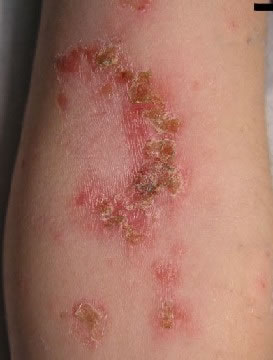
- Cut or scrape looks infected (redness, red streak or pus)
- Cut or scrape and no past tetanus shots. Note: tetanus is the "T" in DTaP, TdaP, or Td vaccines.
- You think your child has a serious injury
- You think your child needs to be seen, and the problem is urgent
Contact Doctor Within 24 Hours
- Very large bruise after a minor injury (2 inches or wider, 5 cm or wider)
- Some bruises appear without any known injury
- Dirty cut or hard to clean and no tetanus shot in more than 5 years
- Clean cut and no tetanus shot in more than 10 years
- You think your child needs to be seen, but the problem is not urgent
Contact Doctor During Office Hours
- Doesn't heal by 10 days
- You have other questions or concerns
Self Care at Home
- Minor cut, scrape or bruise (minor bleeding that stops)
Care Advice for Minor Cuts, Scrapes or Bruises
Cuts, Scratches and Scrapes - Treatment:
- Use direct pressure to stop any bleeding. Do this for 10 minutes or until the bleeding stops.
- Wash the wound with soap and water for 5 minutes. Try to rinse the cut under running water.
- Caution: never soak a wound that might need sutures. Reason: it may become more swollen and harder to close.
- Gently scrub out any dirt with a washcloth.
- Use an antibiotic ointment (such as Polysporin). No prescription is needed. Then, cover it with a bandage. Change daily.
Liquid Skin Bandage for Minor Cuts:
- Liquid skin bandage seals wounds with a plastic coating. It lasts up to 1 week.
- Liquid skin bandage has several benefits compared to other bandages. Liquid bandage only needs to be put on once. It seals the wound and may promote faster healing and lower infection rates. Also, it's water-proof.
- Use for any small break in the skin. Examples are paper cuts, hangnails and cracks on the fingers or toes.
- Wash and dry the wound first. Then, put on the liquid. It comes with a brush or swab. It dries in less than a minute.
- You can get this product at a drugstore near you. There are many brands of liquid bandage. No prescription is needed.
Bruises - Treatment:
- Use a cold pack or ice bag wrapped in a wet cloth. Put it on the bruise once for 20 minutes. This will help to stop the bleeding.
- After 48 hours, use a warm wet wash cloth. Do this for 10 minutes 3 times per day. This helps to reabsorb the blood.
Pain Medicine:
- To help with the pain, give an acetaminophen product (such as Tylenol).
- Another choice is an ibuprofen product (such as Advil).
- Use as needed.
Tetanus Shot:
- A tetanus shot update may be needed for cuts and other open wounds.
- Check your vaccine records to see when your child got the last one.
- For Dirty Cuts and Scrapes. If last tetanus shot was given over 5 years ago, need a booster.
- For Clean Cuts. If last tetanus shot was given over 10 years ago, need a booster.
- See your child's doctor for a booster during regular office hours. It's safe to give it within 3 days or less.
What to Expect:
- Small cuts and scrapes heal up in less than a week.
Call Your Doctor If:
- Bleeding does not stop after using direct pressure to the cut
- Starts to look infected (pus, redness)
- Doesn't heal by 10 days
- You think your child needs to be seen
- Your child becomes worse