Is this your child's symptom?
- A foreign object becomes stuck in the eye
- Also included are small particles such as dirt
- The main symptoms are irritation, pain, tears, and blinking
Types of Foreign Objects in the Eye
- Blowing Dust. Small particles such as sand, dirt, sawdust, or other grit. Can be blown into the eye on a windy day.
- Eyelash. An eyelash is a common finding.
- Dry Mucus. A loose piece of dried mucus (sleep) can feel like something is in the eye.
- Sharp Object (Serious). A piece of glass from a shattered glass ornament is an example.
- High Speed Objects (Serious) such as a metal chip from a hammer or lawnmower. A plastic fragment or small rock thrown from a weed-whacker are other examples.
When to Call for Eye - Foreign Object
Go to ER Now
Call Doctor or Seek Care Now
|
Contact Doctor Within 24 Hours
Contact Doctor During Office Hours
|
Self Care at Home
|
Go to ER Now
- Sharp object in the eye
- Object is a piece of chemical
- Object hit eye at high speed. Examples are a metal chip from hammering, lawnmower, or explosion.
- Object is stuck on the eyeball. Caution: do not try to remove it.
- Tearing or blinking do not stop after washing the eye
- You can't get the object out
Call Doctor or Seek Care Now
- You think your child has a serious injury
- Child refuses to open eye
- Child feels like object still there after eye has been washed out
- Vision not back to normal after eye has been washed out
- You think your child needs to be seen, and the problem is urgent
Contact Doctor Within 24 Hours
- Yellow or green pus occurs
- You think your child needs to be seen, but the problem is not urgent
Contact Doctor During Office Hours
- You have other questions or concerns
Self Care at Home
- Minor object or small particles in the eye (such as an eyelash or dirt). Reason: most likely can be removed at home.
Care Advice for an Object or Small Particles in the Eye
What You Should Know about an Object or Small Particles in the Eye:
- The object (or particles) will always stay in the front part of the eye.
- Some parents worry that it can get lost behind the eyeball.
- This will not happen. The space beyond the eyelids goes back ¼ inch (6 mm) and then stops. In other words, it's a dead end.
- Here is some care advice that should help.
Lots of Particles (such as Dirt or Sand) - Treatment:
- Clean around the eye and face with a wet washcloth first. Reason: so more particles won't get in.
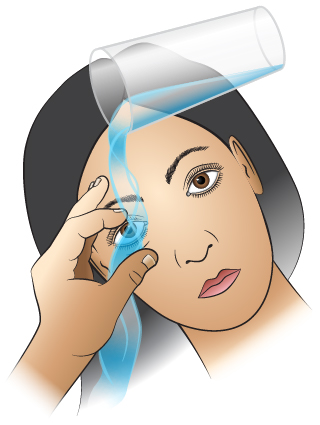
- Put that side of the face in a pan of warm water. Have your child try to open and close the eye while in the water. Do it several times.
- For younger children, fill a glass or pitcher with warm tap water. Pour the water into the eye while holding your child face up. The eyelids must be held open during the rinsing. This process often needs the help of another person.
Particle in a Corner of the Eye - Treatment:
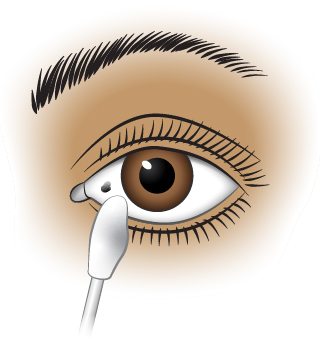
- Try to get it out.
- Use a moistened cotton swab or the corner of a moistened cloth.
Particle Under the Lower Lid - Treatment:
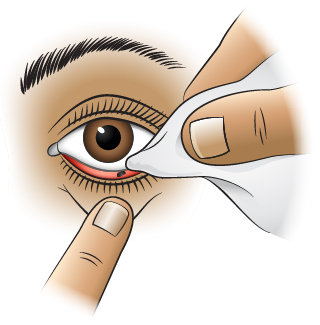
- Pull the lower lid out by pulling down on the skin above the cheekbone.
- Touch the particle with a moistened cotton swab.
- If that doesn't work, try pouring water on the particle. Do this while holding the lid out.
Particle Under the Upper Lid - Treatment:
- If the particle can't be seen, it's probably under the upper lid. This is the most common hiding place.
- Try having your child open and close the eye several times while it is submerged in a pan or bowl of water. If you have an eye cup, use it.
- If this fails, pull the upper lid out. Then, draw it over the lower lid while the eye is closed. When the eye is opened, the particle may come out. The lower lid may sweep the particle out from under the upper lid.
Contact Lenses:
- Children who wear contact lenses need to switch to glasses for a while.
- Reason: to prevent damage to the cornea.
What to Expect:
- The pain, redness and tearing usually pass after the object is removed.
- It may take 1 to 2 hours for these symptoms to fully go away.
Call Your Doctor If:
- You can't get the object or particles out
- Feels like object is still there 2 hours after taken out
- Tearing and blinking do not stop after you take out the object
- Vision is not normal after the eye has been washed out
- You think your child needs to be seen
- Your child becomes worse