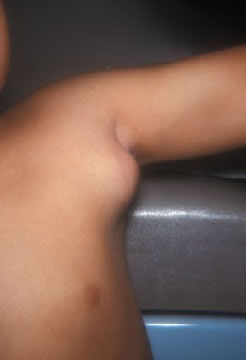
Is this your child's symptom?
- Increased size of one or more lymph nodes. Most are in the neck.
- Also, includes swollen lymph nodes in the armpit or groin
- It's larger than the same node on the other side of the body
- Normal nodes are usually less than ½ inch (12 mm) across. This is the size of a pea or baked bean.
Causes of Swollen Lymph Nodes
- Neck Nodes. The cervical (neck) nodes are most commonly involved. This is because of the many respiratory infections that occur during childhood.
- Viral Throat Infection. This is the most common cause of swollen nodes in the neck. The swollen nodes are usually ½ to 1 inch (12 -25 mm) across. They are the same on each side.
- Bacterial Throat Infection. A swollen node with a bacterial throat infection is usually just on one side. It can be quite large; over 1 inch (25 mm) across. This is about the size of a quarter. Most often, it's the node that drains the tonsil.
- Tooth Decay or Abscess. This causes a swollen, tender node under the jawbone. Only one node is involved. The lower face may also be swollen on that side.
- Armpit Swollen Nodes. Causes include skin infections (such as impetigo). A rash (such as poison ivy) can do the same.
- Groin Swollen Nodes. Causes include skin infections (such as athlete's foot). A retained foreign object (such as a sliver) can be the cause.
- Shaving. Teen girls can cause low-grade infections when shaving the legs.
- Widespread Swollen Nodes. Swollen nodes everywhere suggest an infection spread in the blood. An example is infectious mono. Widespread rashes such as eczema can also cause all the nodes to enlarge.
- Normal Nodes. Lymph nodes can always be felt in the neck and groin. They are about the size of a bean. They never go away.
Lymph Nodes: What They Drain
- The lymph nodes are filled with white blood cells. They filter the lymph fluid coming from certain parts of the body. They fight infections.
- Neck Nodes in Front. These drain the nose, throat and lower face.
- Neck Nodes in Back. These drain the scalp.
- Armpit Nodes. These drain the arms and upper chest wall.
- Groin Nodes. These drain the legs and lower stomach wall.
Common Objects Used to Guess the Size
- Pea or pencil eraser: ¼ inch or 6 mm
- Dime: ¾ inch or 1.8 cm
- Quarter: 1 inch or 2.5 cm
- Golf ball: 1 ½ inches or 3.8 cm
- Tennis Ball: 2 ½ inches or 6.4 cm
When to Call for Lymph Nodes - Swollen
Call Doctor or Seek Care Now
|
Contact Doctor Within 24 Hours
Contact Doctor During Office Hours
|
Self Care at Home
|
Call Doctor or Seek Care Now
- Node in the neck causes trouble with breathing, swallowing or drinking
- Fever higher than 104° F (40° C)
- Skin over the node is red
- Node gets much bigger over 6 hours or less
- Fever in baby less than 12 weeks old. Caution: do NOT give your baby any fever medicine before being seen.
- Your child looks or acts very sick
- You think your child needs to be seen, and the problem is urgent
Contact Doctor Within 24 Hours
- 1 or more inches (2.5 cm or more) in size by measurement
- Very tender to the touch
- Age less than 3 months old
- Node limits moving the neck, arm or leg
- Toothache with a swollen node under the jawbone
- Fever lasts more than 3 days
- You think your child needs to be seen, but the problem is not urgent
Contact Doctor During Office Hours
- In the neck and also has a sore throat
- Large nodes at 2 or more parts of the body
- Cause of the swollen node is not clear
- Large node lasts more than 1 month
- You have other questions or concerns
Self Care at Home
- Mildly swollen lymph node
Care Advice for Small Lymph Nodes
What You Should Know About Normal Nodes:
- If you have found a pea-sized or bean-sized node, this is normal. Normal lymph nodes are smaller than ½ inch or 12 mm.
- Don't look for lymph nodes, because you can always find some. They are easy to find in the neck and groin.
What You Should Know About Swollen Nodes from a Viral Infection:
- Viral throat infections and colds can cause lymph nodes in the neck to get bigger. They may double in size. They may also become tender.
- This reaction is normal. It means the lymph node is fighting the infection and doing a good job.
- Here is some care advice that should help.
Pain Medicine:
- To help with the pain, give an acetaminophen product (such as Tylenol).
- Another choice is an ibuprofen product (such as Advil).
- Use as needed.
Fever Medicine:
- For fevers higher than 102° F (39° C), give an acetaminophen product (such as Tylenol).
- Another choice is an ibuprofen product (such as Advil).
- Note: fevers less than 102° F (39° C) are important for fighting infections.
- For all fevers: keep your child well hydrated. Give lots of cold fluids.
Do Not Squeeze:
- Don't squeeze lymph nodes.
- Reason: this may keep them from shrinking back to normal size.
Return to School:
- Swollen lymph nodes alone cannot be spread to others.
- If the swollen nodes are with a viral illness, your child can return to school. Wait until after the fever is gone. Your child should feel well enough to participate in normal activities.
What to Expect:
- After the infection is gone, the nodes slowly return to normal size.
- This may take 2 to 4 weeks.
- However, they won't ever completely go away.
Call Your Doctor If:
- Node gets 1 inch (2.5 cm) or larger in size
- Big node lasts more than 1 month
- You think your child needs to be seen
- Your child becomes worse