Is this your child's symptom?
- Sting from a scorpion
- Onset of local pain and tingling after a scorpion is seen in the area
- The main symptoms are pain, tingling and numbness at the sting site
Scorpions
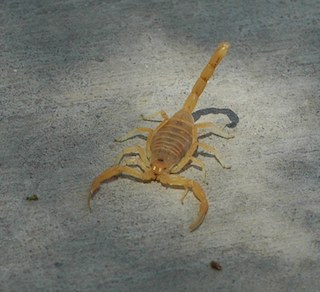
- Scorpions look like tiny lobsters in front. In back, they have a long tail with a stinger at the end. It curls up and over their bodies. They have 8 legs, like spiders.
- Venom: the stinger has venom. The venom causes pain and other symptoms when it is shot into the skin.
- Size: average size is 3 inches (7.5 cm). Range in size from 1 - 7 inches (2.5 to 18 cm).
- Scorpions are most active at night. They like dark and moist places.
- There are about 40 types of scorpions in the US.
- All scorpions can sting, causing pain, tingling, and numbness at the sting site. Note: Some stings do not inject venom.
- The only US scorpion that can cause serious symptoms is the bark scorpion. See below.
- Children and older adults are more likely to have severe symptoms. People with chronic medical problems are also at higher risk.
Bark Scorpion
- The only US scorpion that can cause serious symptoms is the bark scorpion.
- Color: bark scorpions are yellow-brown (tan) or orange in color.
- Size: 2-3 inches long (5-7.5 cm)
- They are found mostly in Arizona. Also can be found in New Mexico, Nevada, California, and Texas. They also live in Mexico, Central America, and the Caribbean.
- Deaths in the US from a scorpion sting are rare.
- Note: most people cannot tell a bark scorpion from a harmless scorpion. Catching or saving the scorpion to show your doctor is not helpful. Treatment is based on symptoms. Just kill the intruder.
Types of Reactions for Bark Scorpion Stings
- About 85% cause only local symptoms at the sting site.
- About 10% cause painful shock waves in the same arm or leg as the sting.
- Less than 5% cause any serious symptoms.
Mild Symptoms of a Scorpion Sting
- All scorpion stings cause pain, tingling, and numbness at the sting site.
- Pain starts right away. The pain can be severe for the first 2 hours. Symptoms around the site start to go away over the next 24 hours.
- There is often no swelling or redness of the sting.
- About 10% of stings also cause waves of tingling. The tingling travels up the stung arm or leg. It feels like an electric shock.
- Most scorpion stings do not need to be seen.
Serious Symptoms of a Scorpion Sting
Most people will not get any serious symptoms. If they do occur, they will start in the first 2-3 hours after the sting. First signs of a serious sting can be muscle twitching or rapid eye movements. Pain, tingling and numbness can also spread to all the arms and legs. Other serious symptoms include:
- Trouble swallowing
- Trouble breathing
- Blurry eyesight
- Roving or jerky eye movements
- Slurred speech
- Muscle twitching
Expert Reviewers:
- Anne-Michelle Ruha, MD, and Min Kang, MD, pediatric toxicologists
When to Call for Scorpion Sting
Call 911 Now
Go to ER Now
Call Doctor or Seek Care Now
|
Call Poison Center Now
Contact Doctor Within 24 Hours
Contact Doctor During Office Hours
|
Self Care at Home
|
Call 911 Now
- Passed out (fainted) or too weak to stand
- Trouble breathing or wheezing
- Drooling or trouble swallowing
- Seizure or muscle jerking
- Hives or swelling all over the body
- You think your child has a life-threatening emergency
Go to ER Now
- Jerky eye movements or vision problems
- Mild muscle twitching
- Child is restless (can't sit still)
- Child crying and can't be comforted
Call Doctor or Seek Care Now
- Spreading redness with fever
- Scorpion sting and No past tetanus shots. Note: tetanus is the "T" in DTaP, TdaP, or Td vaccines.
Call Poison Center Now
- Any symptoms occur in other parts of the body. Note: symptoms that only spread up the stung arm or leg are safe.
- Age less than 2 years old
- Sting caused by known bark scorpion
- Your child looks or acts very sick
- You think your child needs to be seen, and the problem is urgent
Contact Doctor Within 24 Hours
- Spreading redness that started more than 48 hours after the sting
- Last tetanus shot was more than 10 years ago
- You think your child needs to be seen, but the problem is not urgent
Contact Doctor During Office Hours
- You have other questions or concerns
Self Care at Home
- Minor scorpion sting with symptoms only around the sting
- Waves of tingling and pain only up the arm or leg with the sting
- Preventing scorpion stings
Care Advice
Scorpion Sting Treatment
What You Should Know about Scorpion Stings:
- The main symptoms are pain, tingling and numbness only in the sting area.
- Symptoms shouldn't be any worse than a bad bee sting.
- Sometimes, the arm or leg with the sting gets waves of tingling and pain.
- Here is some care advice that should help.
Clean the Sting Site:
- Wash the sting site well with soap and water.
Cold Pack for Pain:
- For pain or swelling, use a cold pack. You can also use ice wrapped in a wet cloth.
- Put it on the sting for 20 minutes.
Pain Medicine:
- To help with the pain, give an acetaminophen product (such as Tylenol).
- Another choice is an ibuprofen product (such as Advil).
- Use as needed.
Treatment of Painful Shock Waves up the Arm or Leg:
- Until they go away, keep using the pain medicine as needed.
- Also, try to avoid bumping that arm or leg.
What to Expect:
- Pain at the sting site is usually gone by 24 hours.
- Shock waves of tingling also gone by 24 hours.
- Numbness and tingling around the sting may last 2 to 3 days.
Call Your Doctor If:
- Serious symptoms occur
- Pain, tingling or numbness start on both sides of the body
- Muscle jerks or twitching occur
- You think your child needs to be seen
- Your child becomes worse
Prevent Scorpion Stings
Prevent Scorpion Stings:
- Do not walk barefoot in the desert, especially at night. Scorpions are most active at night.
- Check your shoes before you put them on (shake them).
- Shake out clothes, towels, bedding, and sleeping bags before using.
- Roll back your sheets at night, before getting into bed.
Prevent Scorpions Around Your Home:
- Clear away any piles of wood or debris that are near the house. Scorpions hide there.
- Weatherstrip your windows and doors.
- Place the legs of a baby's crib in wide-mouthed glass jars. Scorpions can't climb glass.
- Hire a pest control expert for repeated problems.
Call Your Doctor If:
- You have more questions